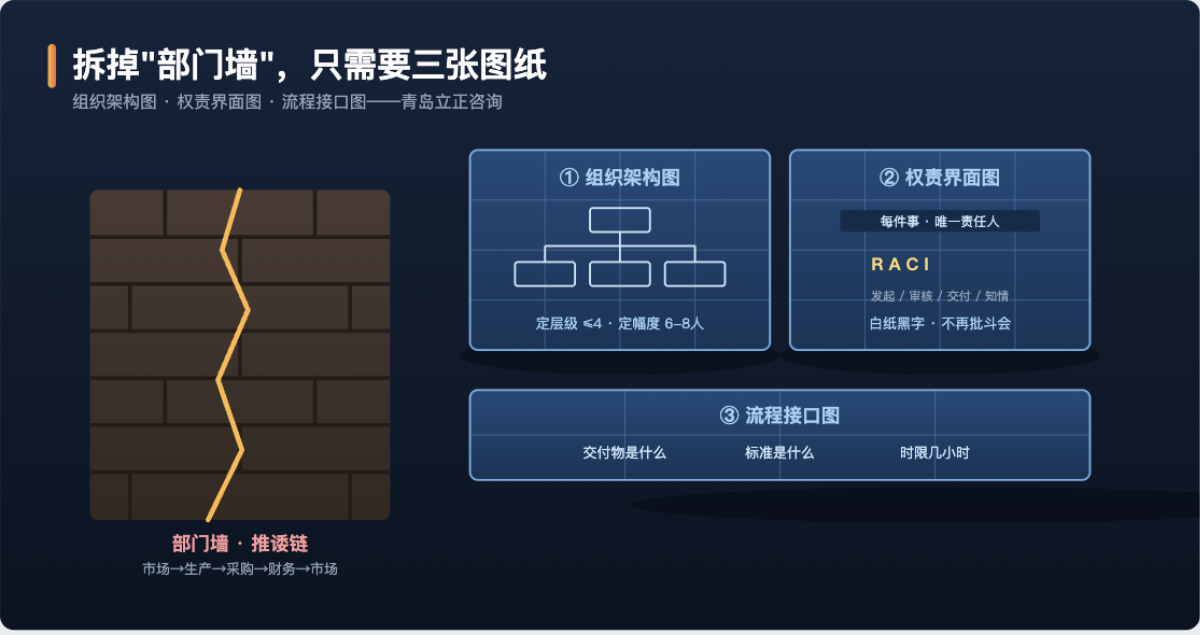
First, a scene every owner knows by heart.
A manufacturer ships a quality defect; the customer claims compensation. The boss convenes an accountability meeting: sales blames production for missing dates, production blames purchasing for inferior material, purchasing blames finance for squeezing payments, finance blames sales for blowing the budget. <strong>Two hours later, responsibility has traveled a full circle through the departments — nobody is wrong, and nobody is responsible.</strong> The boss slams the table and adjourns; nothing changes.
Such "blame chains" are not a failure of character but of <strong>organizational interfaces that were never drawn.</strong> Department walls are a design problem, not a moral one — you built them, you can tear them down.
Tearing them down takes exactly three drawings.
<strong>Drawing 1: The organization chart — levels and spans</strong>
A chart is not wall decoration; it answers two hard questions: <strong>levels</strong> and <strong>span of control.</strong>
Rules of thumb: keep levels to four or fewer — each extra layer attenuates information and slows decisions; keep direct reports at six to eight — under four is an honor guard, over twelve is unmanaged.
<strong>Drawing 2: The responsibility interface — one owner per matter</strong>
Accountability meetings turn into "struggle sessions" because <strong>boundaries are blurred</strong>: on any cross-department matter, everyone touches it, no one owns it.
The method is plain: list the twenty cross-department matters that most often go wrong (order review, procurement change, quality exceptions, customer complaints…), and for each mark four roles — <strong>who initiates, who approves, who delivers, who is informed</strong> — one owner, in black and white.
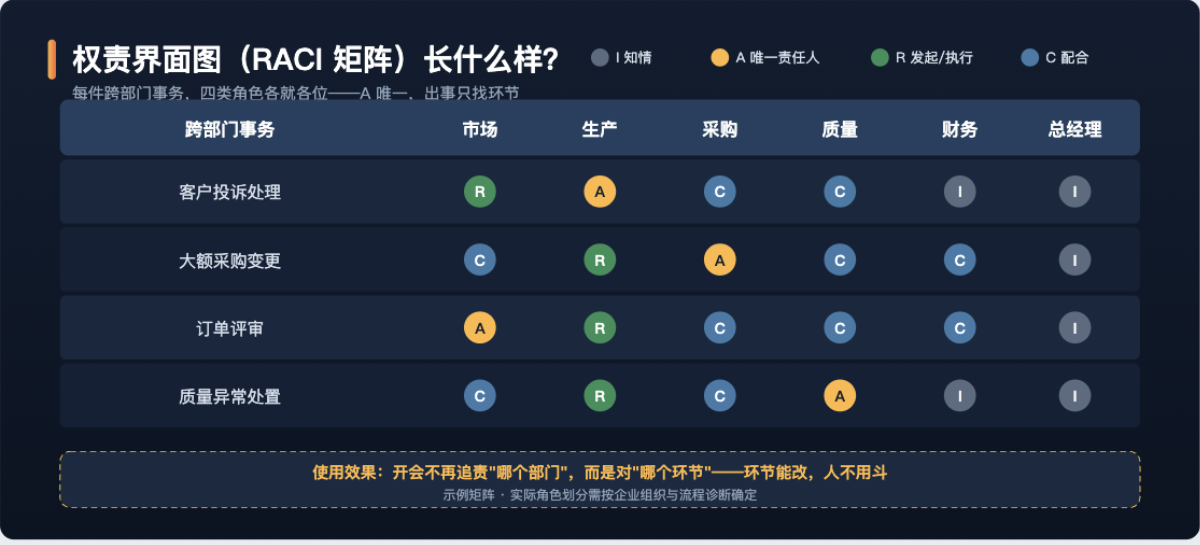
The immediate change after this drawing: <strong>meetments stop blaming "which department" and start fixing "which step" — steps can be fixed; people need not fight.</strong>
<strong>Drawing 3: The process interface — handoffs with deadlines and standards</strong>
The other half of the wall is <strong>undefined handoffs</strong>. Sales "tosses" requirements to production, production " forwards" anomalies to quality — no standard, no deadline, no receipt; everything rides on tacit understanding and temper.
The process interface pins three things at every handoff: <strong>what is delivered, to what standard, within how many hours.</strong> For example: "Customer complaint: quality issues a preliminary judgment within 2 hours; production submits corrective action within 24 hours" — handoffs become workstations, everything with a receipt.
<strong>Drawings done, then make them stick</strong>
Drawings alone generate no execution. Our way is <strong>on-site coaching</strong>: drawing the three pictures with the client is only the start — then three months of running alongside: correcting drift, unblocking jams, teaching newcomers. <strong>The resistance to organizational change lives entirely in people; drawings draw walls, people tear them down.</strong> That is what one-year-plus after-sales coaching is for.
<strong>Six-point self-check: how thick are your walls?</strong>
1. Cross-department problems get a "struggle session" before any solution<br>2. On important matters, three people think they own it — or none does<br>3. Handoffs run on instant messages, without deadlines or receipts<br>4. The org chart is three years old and out of step with strategy<br>5. Middle managers relay upward and forward, nothing more<br>6. Department KPIs fight: sales wants speed, production stability, finance savings
More than three, and the walls are thick enough to slow growth — time to draw.
Small companies run on relationships; big ones run on interfaces. <strong>Every wall torn down returns the boss, for a day, from fire chief to entrepreneur.</strong>
Three drawings: drawn for the organization, healing for the hearts.