This year, visiting manufacturers, the question owners ask most has become: "This AI thing — should we get on board?"
The urgency signals anxiety. My answer usually surprises them: <strong>don't rush to "adopt AI" — first answer one question: where is your data sleeping right now?</strong>
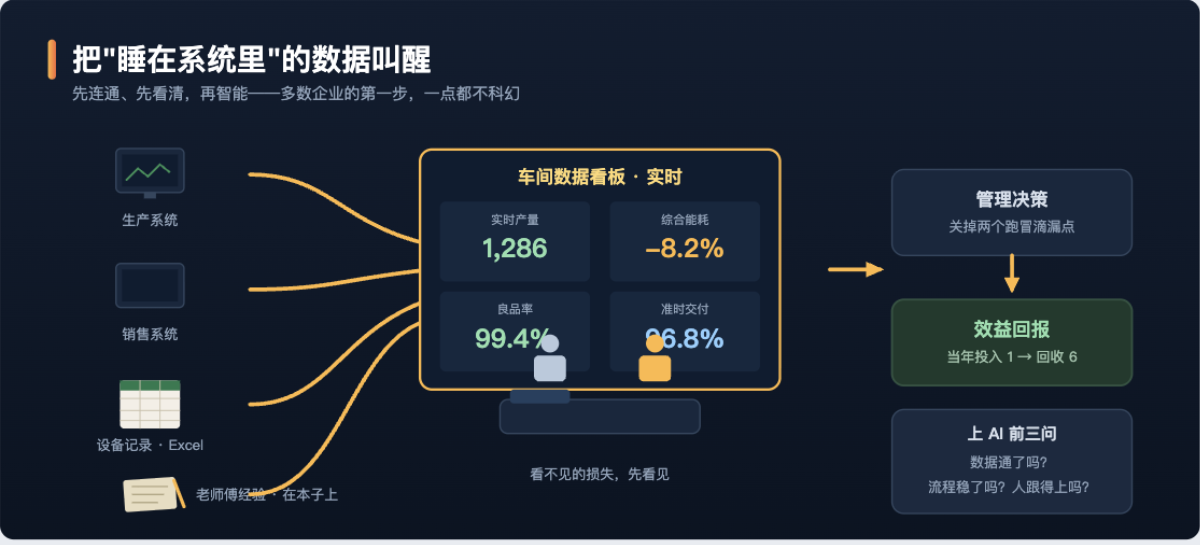
A chemical company's real scene: production data in one system, sales in another, maintenance records in Excel, the veterans' process parameters in notebooks. The owner wanted "AI decision-making"; our first move was not algorithms but <strong>connecting and seeing</strong> the data. Three months later, with zero "high tech," a real-time dashboard of equipment, energy and quality had <strong>found and closed two chronic leak points — payback six times the cost, in the same year.</strong>
That is the truth of traditional enterprises going digital: <strong>the most profitable first step is usually not science fiction at all.</strong>
<strong>1. For manufacturers, the AI value ranking looks like this</strong>
Ranked by speed-to-result × investment:
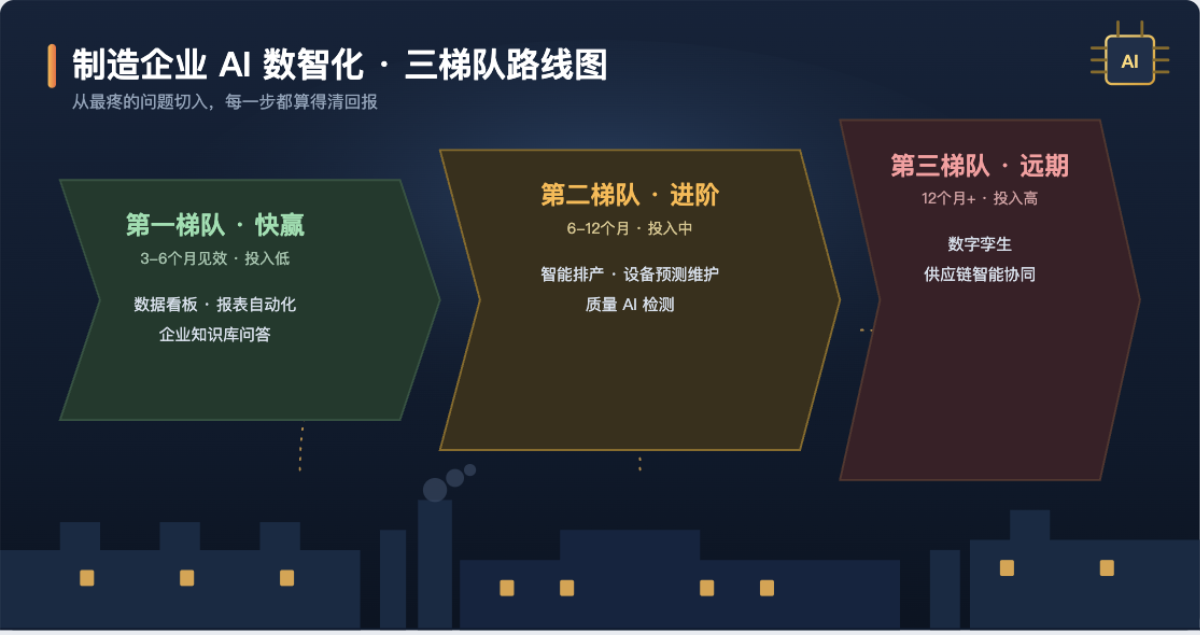
<strong>Tier 1 (results in 3–6 months, low investment):</strong> data dashboards — see the invisible losses first; automated reporting — manual consolidation eats dozens of hours monthly, machines do it in seconds; knowledge-base Q&A — newcomers ask the AI instead of waiting for the master.
<strong>Tier 2 (6–12 months, medium):</strong> intelligent scheduling — utilization typically yields another 5–15%; predictive maintenance — from "fix when broken" to "fix before broken"; AI visual inspection — steady and never tired.
<strong>Tier 3 (12+ months, high):</strong> full-process digital twins, intelligent supply-chain coordination.
<strong>Most mid-sized manufacturers that nail Tier 1 have already left their peers a length behind.</strong> The tragic script runs the other way: charge at Tier 3 on day one, and the system starts gathering dust the day it launches.
<strong>2. The master's head is the most expensive database</strong>
A quiet pain runs through Shandong manufacturers: <strong>critical process know-how lives in a few veterans' heads.</strong> When they retire, resign or take leave, the line wobbles.
What we value most in AI enablement is <strong>turning experience in heads into assets in hand</strong>: structuring the veterans' tuning methods and fault logic into a process-parameter and case library with AI retrieval — a newcomer types the symptom, the system returns the diagnostic path. Unromantic, but it is the digital version of moving from "relying on people" to "relying on systems."
<strong>3. Before AI: three soul-searching questions</strong>
1. <strong>Is the data connected?</strong> Islands unconnected means AI cooks without rice;<br>2. <strong>Are the processes stable?</strong> No standard work, and AI merely accelerates the chaos;<br>3. <strong>Can the people keep up?</strong> Seven in ten digital failures die of "system launched, people won't use" — change management beats technology selection.
Fail these three, go back to class; pass them, and every yuan of AI spends audibly.
<strong>Six-point self-check: is your data asleep?</strong>
1. Monthly analysis needs three days of manual consolidation across departments<br>2. Equipment data sits unread in systems<br>3. One metric, three numbers from three departments<br>4. Critical parameters passed down by word of mouth<br>5. New hires need six months of apprenticeship to function<br>6. The boss cannot get one real-time page of business status
More than three — your company pays interest on sleeping data every day.
AI is not a fad; it is a toolbox. <strong>What enterprises need is not the ceremony of "using AI" but certain increments of efficiency and profit.</strong> Diagnose first, connect first, win first — then advance.