A Chinese equipment maker supplied a German customer. The equipment arrived, failed acceptance, and was returned in full. The inspection puzzled the Chinese engineers — every single bolt was tight, not one loose.
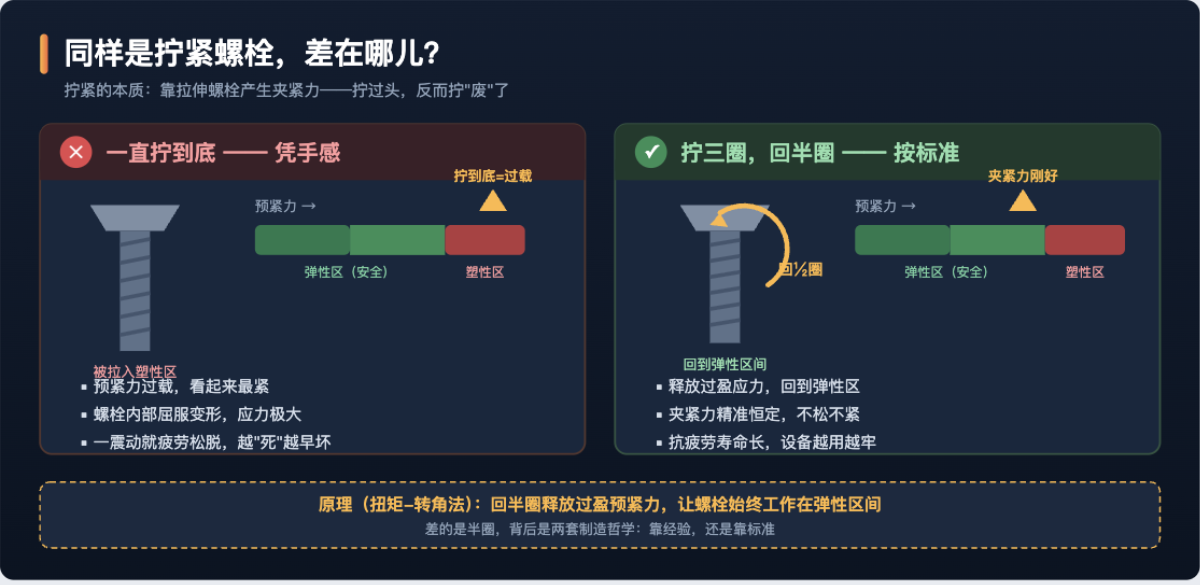
The German reply: <strong>"You tightened the bolts `all the way down` — but our standard is `three turns forward, half a turn back`."</strong>
Three turns, then half a turn back? Superfluous? Not at all.
<strong>1. What does the half turn give back?</strong>
Tightening a bolt works by stretching it to create clamping force, gripping two parts together.
<strong>Tighten all the way down</strong> and the bolt enters the "plastic zone" — the material is stretched into slight yield. It looks tightest, but the preload is overloaded and internal stress extreme; vibration and thermal cycling multiply the risk of fatigue failure. The tighter it is "dead," the earlier it fails.
<strong>Three turns then half a turn back</strong> returns the bolt to the "elastic zone" — that half turn of release sheds exactly the excess stress, landing clamping force within design range: not loose, not tight, durable and constant.
Same bolt, same wrench: one tightens by feel "as far as it will go," the other to standard "just right." The difference is half a turn — <strong>behind it stand two philosophies of manufacturing: experience versus standard.</strong><br>The strength of German manufacturing lies not in stronger arms but in a validated standard behind every motion. This is the first principle of lean production — <strong>turning the master's touch into standards everyone can execute, replicate and audit.</strong>
<strong>2. Three real slices from the shop floor</strong>
<strong>Slice one: orders doubled, capacity stood still.</strong> A manufacturer's orders doubled while output idled. The boss ordered overtime — ten hours a day, output unmoved. Diagnosis found the line's yield capped by one bottleneck operation. <strong>Whatever the bottleneck produces per hour, the factory produces per hour</strong> — everything else is busy idleness. Three focused improvements later, no new machines, capacity up 40%, overtime cancelled first.
<strong>Slice two: the more they repaired, the worse it got.</strong> A maintenance crew firefighting daily. The log showed the same failure on the same machine seven times a year — <strong>always treating the symptom, never the cause.</strong> After TPM, ten minutes of daily operator inspection cut downtime by more than half; the crew turned from firefighters into fire preventers.
<strong>Slice three: messy floor, low efficiency.</strong> A food company needed ten minutes to find a tool and ran FIFO on memory. After 6S fixed-location management and visual control, retrieval dropped to ten seconds. <strong>Shop-floor management is the foundation of a factory's efficiency.</strong>
<strong>3. The lean map: seven wastes</strong>
Everything lean production does comes down to one thing: <strong>find and eliminate every action that creates no value.</strong>

Check your plant against the list — most factories tick all seven. <strong>Waste is not the employees' fault; the system makes waste look normal.</strong>
<strong>4. How to start: a four-step path</strong>

<strong>Step one, gemba diagnosis.</strong> Establish where bottlenecks, waste and losses are and what they cost — our habit is to do this step free; the report shows the data, and the owner decides.
<strong>Step two, bottleneck breakthrough.</strong> Concentrate on the one or two points of greatest leverage — usually visible within 45 days.
<strong>Step three, standard work.</strong> Write the gains into standard work sheets and lock them with visual boards — so improvements survive personnel changes.
<strong>Step four, continuous improvement.</strong> Grow the company's own improvement backbone and make improvement everyone's daily business.
From "all the way down" to "half a turn back": that half turn is the distance between an ordinary factory and an excellent one.